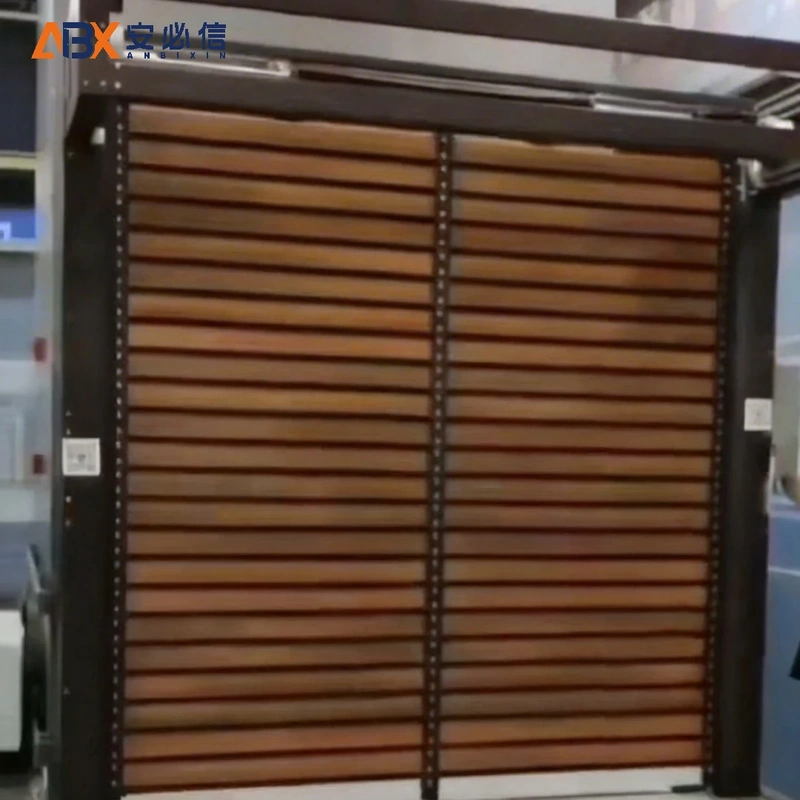
Industrial Overhead Door Solutions for the Electronics Industry is a set of door, sealing and control configurations for electronics manufacturing cleanrooms, where the main concerns are particle control, airlock pressure stability and ESD-safe traffic. A rigid high-speed door is a powered industrial door built from rigid insulated slats that opens and closes at high speed, combining wind resistance, security and temperature separation at high-traffic openings.
Maintenance items that determine service life
The most common unplanned stops come from misaligned guides, contaminated photocells and a tired bottom seal rather than from the motor. Keeping a cleaning and inspection log shortens diagnosis time substantially.
Temperature separation and condensation
Where electronics manufacturing cleanrooms places a cold zone next to a warm one, the door assembly becomes the coldest surface in the room. Condensation appears first on the guides, the threshold and the bottom seal.
For the rigid high-speed door, frame heating, a drainable threshold and a finish that tolerates the cleaning regime are usually more effective than raising the opening speed.
Operating conditions in electronics manufacturing cleanrooms
An airlock is a sequence, not a single door: the two leaves should not be open at the same time.
- Electrostatic discharge requirements affect surface materials and the way personnel and carts move through the opening.
- Frequent short crossings make opening time and closing delay more significant than the nominal top speed.
- Cleaning agents used in the area must be compatible with the curtain, seals and guide materials.
- Particle control depends on keeping the pressure cascade stable while people and materials pass through the airlock.
Configuration by opening position in electronics cleanroom and assembly areas
The table maps positions that commonly appear in electronics manufacturing cleanrooms to the configuration items that belong in the door schedule. On this page the review focuses on temperature separation and condensation.
| Opening position | Configuration to verify |
|---|---|
| Material transfer airlock | Bottom airbag seal plus side sealing gaskets — Coordinate the opening with cart and conveyor movement |
| Assembly-to-test partition | Variable-frequency drive with soft start/stop — Limit particle carry-over during short crossings |
| ESD-controlled corridor | Safety edge and photocell coverage across the opening — Select surfaces compatible with the area's ESD regime |
| Goods-in buffer | Heated guides where condensation or frost is expected — Separate external dust from the internal clean zone |
Configuration detail
- Heated guides where condensation or frost is expected
- Wind class verified against EN 12424 for the building elevation
- Rigid insulated slat package with spiral guide
- Bottom airbag seal plus side sealing gaskets
- Variable-frequency drive with soft start/stop
Where this construction is not the first choice
For very large spans or strongly flexible openings, a stacking door is usually a better structural match than a rigid slat curtain.
Specifying rigid high-speed doors for electronics manufacturing cleanrooms
For electronics manufacturing cleanrooms, the starting point is structural strength and wind resistance. It combines a fast cycle with a rigid, sealed curtain, so the opening can stay on an exposed elevation without losing its wind class or its temperature separation. The checks below should be resolved against the project door schedule before an order is placed.
- Agree the service interval and the spare parts held on site.
- Confirm the clear opening width and the available headroom for the slat stack.
- State the wind class required for the elevation and its exposure.
- Record the expected daily cycle count against the drive duty rating.
- Specify the safety devices and their interlocks with adjacent equipment.
Frequently asked questions
Where does condensation first become a problem?
On the coldest components of the assembly — normally the guides, the threshold and the bottom seal — not on the curtain or the panel face.
Why are rigid high-speed doors considered for electronics manufacturing cleanrooms?
It combines a fast cycle with a rigid, sealed curtain, so the opening can stay on an exposed elevation without losing its wind class or its temperature separation. An airlock is a sequence, not a single door: the two leaves should not be open at the same time.
Which configuration items should be stated in the door schedule?
At minimum: Variable-frequency drive with soft start/stop; Safety edge and photocell coverage across the opening; Heated guides where condensation or frost is expected. Final values depend on the measured opening and the site conditions.
What is Industrial Overhead Door Solutions for the Electronics Industry?
Industrial Overhead Door Solutions for the Electronics Industry is a set of door, sealing and control configurations for electronics manufacturing cleanrooms, where the main concerns are particle control, airlock pressure stability and ESD-safe traffic.
Drive, control and safety interfaces
Control is normally PLC-based. Opening commands may come from radar, induction loops, pull cords or a warehouse management system; the controller must also accept interlocks from conveyors, airlocks and dock levellers before a cycle is allowed.
Standards and parameters to verify
The items below are the references normally reviewed when the specification is checked on site. The standards named are the references normally used when reviewing an industrial door specification; they are not a certification claim for any specific installation.
| Reference | What to verify |
|---|---|
| EN 12424 | Wind resistance classification for the exposed elevation |
| EN 12425 | Resistance to water penetration |
| EN 12426 | Air permeability of the closed door |
| EN 12428 | Thermal transmittance where temperature separation is required |
| EN 12453 | Safety in use of power-operated doors |
| EN 12604 | Mechanical aspects of doors and gates |
| EN 13241 | Product standard for industrial, commercial and garage doors and gates |
| Typical operating speed | 0.5-1.2 m/s across models in this product family; confirm the required cycle time before selection. |
Final values for rigid high-speed doors depend on opening size, cycle duty and site conditions.
Gallery