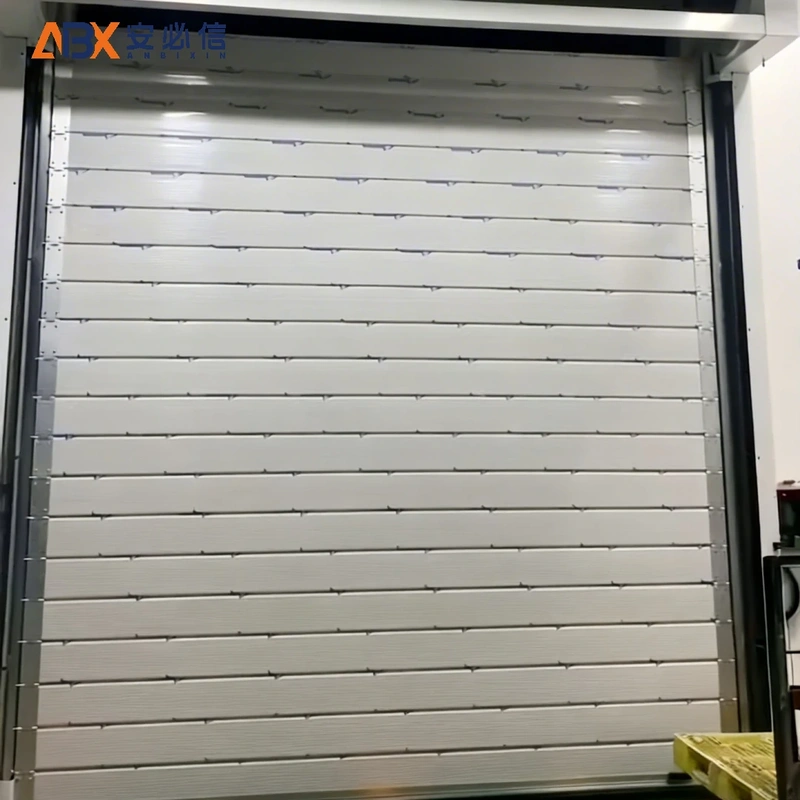
Industrial Overhead Door Solutions for the Food Industry is a set of door, sealing and control configurations for food processing plants, where the main concerns are hygiene zoning, washdown cleaning, and pest and dust exclusion. A rigid high-speed door is a powered industrial door built from rigid insulated slats that opens and closes at high speed, combining wind resistance, security and temperature separation at high-traffic openings.
Traffic pattern and cycle duty
The real specification in food processing plants comes from the traffic pattern: how many cycles per day, how long the opening stays clear and whether pedestrians share the route with vehicles.
The rigid high-speed door should be rated against that duty figure. A nominal top speed says little about availability if the drive, brake and controller are sized for a lighter pattern.
Operating conditions in food processing plants
Pest and dust exclusion depends on how short the opening time is and how well the closed door seals at the threshold.
- Chilled and ambient zones sitting next to each other create condensation at the door interface, especially around the guides.
- Forklift traffic between production, packing and cold storage sets the real cycle count and the required visibility through the opening.
- Hygiene zoning separates raw, processed and packaged goods; each transfer point is a potential cross-contamination route.
- Washdown routines expose the door, guides and header box to water and cleaning agents, so surfaces must be accessible and the materials compatible.
Configuration by opening position in food production and processing areas
The table maps positions that commonly appear in food processing plants to the configuration items that belong in the door schedule. On this page the review focuses on traffic pattern and cycle duty.
| Opening position | Configuration to verify |
|---|---|
| Chilled-to-ambient transfer | Variable-frequency drive with soft start/stop — Manage condensate at the guides and the threshold |
| Packing and dispatch bay | Safety edge and photocell coverage across the opening — Match closing delay to the forklift traffic pattern |
| Dry goods warehouse portal | Heated guides where condensation or frost is expected — Control dust migration between storage areas |
| Between raw and ready-to-eat zones | Wind class verified against EN 12424 for the building elevation — Define the hygiene boundary and keep the opening time short |
Configuration detail
- Wind class verified against EN 12424 for the building elevation
- Rigid insulated slat package with spiral guide
- Bottom airbag seal plus side sealing gaskets
- Variable-frequency drive with soft start/stop
- Safety edge and photocell coverage across the opening
Where this construction is not the first choice
For very large spans or strongly flexible openings, a stacking door is usually a better structural match than a rigid slat curtain.
Specifying rigid high-speed doors for food processing plants
For food processing plants, the starting point is structural strength and wind resistance. It combines a fast cycle with a rigid, sealed curtain, so the opening can stay on an exposed elevation without losing its wind class or its temperature separation. The checks below should be resolved against the project door schedule before an order is placed.
- Confirm the clear opening width and the available headroom for the slat stack.
- State the wind class required for the elevation and its exposure.
- Record the expected daily cycle count against the drive duty rating.
- Specify the safety devices and their interlocks with adjacent equipment.
- Check the sealing arrangement at the threshold and the side guides.
Frequently asked questions
Why are rigid high-speed doors considered for food processing plants?
It combines a fast cycle with a rigid, sealed curtain, so the opening can stay on an exposed elevation without losing its wind class or its temperature separation. Pest and dust exclusion depends on how short the opening time is and how well the closed door seals at the threshold.
Which configuration items should be stated in the door schedule?
At minimum: Safety edge and photocell coverage across the opening; Heated guides where condensation or frost is expected; Wind class verified against EN 12424 for the building elevation. Final values depend on the measured opening and the site conditions.
What is Industrial Overhead Door Solutions for the Food Industry?
Industrial Overhead Door Solutions for the Food Industry is a set of door, sealing and control configurations for food processing plants, where the main concerns are hygiene zoning, washdown cleaning, and pest and dust exclusion.
Which traffic figure should be used when specifying the door?
The expected number of opening cycles per day, together with the proportion of time the aperture is actually clear; these set the drive duty and the closing delay.
Sealing, insulation and condensation
Where a cold room meets a warm loading bay, moisture will condense on the coldest surface in the assembly. Specifying heated guides, a drainable threshold and a corrosion-resistant finish addresses that failure mode more reliably than increasing curtain speed.
Where rigid slat construction changes the specification
The defining difference is mechanical: a geared drive moves a rigid slat package along a fixed track at high speed. That construction allows a sealed perimeter and a measurable wind class, at the cost of more headroom and a heavier structure.
Standards and parameters to verify
The door schedule should state which of the following references apply and how compliance will be evidenced. The standards named are the references normally used when reviewing an industrial door specification; they are not a certification claim for any specific installation.
| Reference | What to verify |
|---|---|
| EN 12425 | Resistance to water penetration |
| EN 12426 | Air permeability of the closed door |
| EN 12428 | Thermal transmittance where temperature separation is required |
| EN 12453 | Safety in use of power-operated doors |
| EN 12604 | Mechanical aspects of doors and gates |
| EN 13241 | Product standard for industrial, commercial and garage doors and gates |
| EN 12424 | Wind resistance classification for the exposed elevation |
| Typical operating speed | 0.5-1.2 m/s across models in this product family; confirm the required cycle time before selection. |
Final values for rigid high-speed doors depend on opening size, cycle duty and site conditions.
Gallery