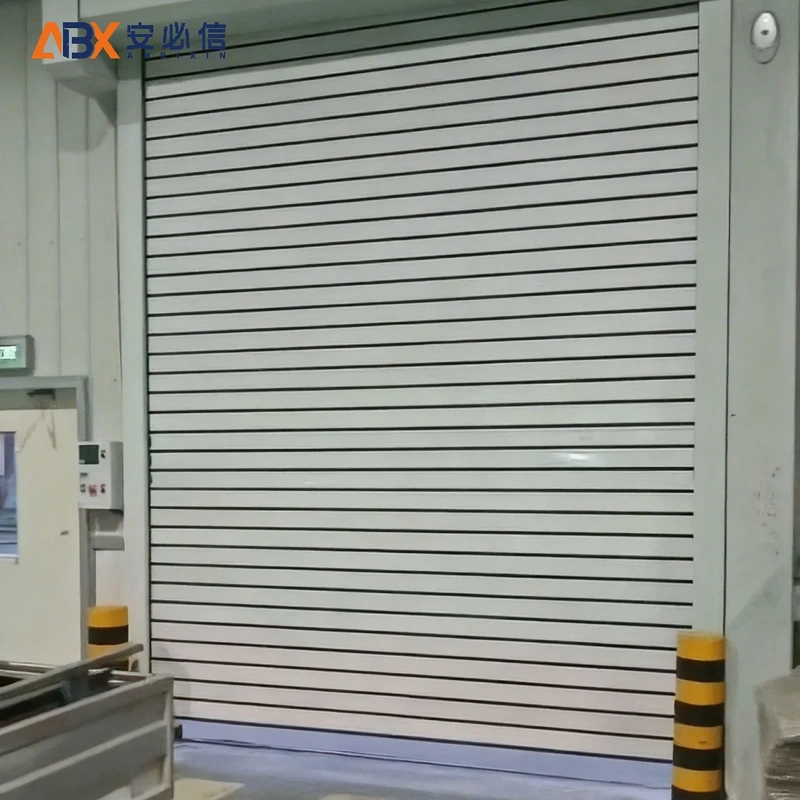
Electric Overhead Door Solutions for the Automotive Industry is a set of door, sealing and control configurations for automotive parts manufacturing, where the main concerns are high-cycle forklift traffic, large openings and impact tolerance. A rigid high-speed door is a powered industrial door built from rigid insulated slats that opens and closes at high speed, combining wind resistance, security and temperature separation at high-traffic openings.
Configuration detail
- Variable-frequency drive with soft start/stop
- Safety edge and photocell coverage across the opening
- Heated guides where condensation or frost is expected
- Wind class verified against EN 12424 for the building elevation
- Rigid insulated slat package with spiral guide
Where this construction is not the first choice
For very large spans or strongly flexible openings, a stacking door is usually a better structural match than a rigid slat curtain.
Specifying rigid high-speed doors for automotive parts manufacturing
For automotive parts manufacturing, the starting point is structural strength and wind resistance. It combines a fast cycle with a rigid, sealed curtain, so the opening can stay on an exposed elevation without losing its wind class or its temperature separation. The checks below should be resolved against the project door schedule before an order is placed.
- Specify the safety devices and their interlocks with adjacent equipment.
- Check the sealing arrangement at the threshold and the side guides.
- Agree the service interval and the spare parts held on site.
- Confirm the clear opening width and the available headroom for the slat stack.
- State the wind class required for the elevation and its exposure.
Frequently asked questions
Which site dimensions must be settled before ordering?
Clear width, clear height, available headroom for the parked leaf, and the structural capacity of the jambs and header to carry the fixings.
Why are rigid high-speed doors considered for automotive parts manufacturing?
It combines a fast cycle with a rigid, sealed curtain, so the opening can stay on an exposed elevation without losing its wind class or its temperature separation. Forklift and tow-train traffic cycles the door continuously, so drive duty and closing delay dominate the specification.
Which configuration items should be stated in the door schedule?
At minimum: Rigid insulated slat package with spiral guide; Bottom airbag seal plus side sealing gaskets; Variable-frequency drive with soft start/stop. Final values depend on the measured opening and the site conditions.
What is Electric Overhead Door Solutions for the Automotive Industry?
Electric Overhead Door Solutions for the Automotive Industry is a set of door, sealing and control configurations for automotive parts manufacturing, where the main concerns are high-cycle forklift traffic, large openings and impact tolerance.
Drive, control and safety interfaces
Commissioning sets the travel limits, the closing delay and the reversal sensitivity of the bottom edge. Those values should be recorded against the site door schedule, because a later change of traffic pattern usually requires re-tuning them.
Maintenance items that determine service life
Because the door cycles frequently, the drive duty rating and the balance adjustment should be reviewed together. A door that is correctly balanced places far less load on the gearbox and the brake.
Headroom, structure and installation interfaces
Before a door is selected for automotive parts manufacturing, the headroom, the jamb construction and the position of sprinklers, lighting and conveyors above the opening have to be measured on site.
The rigid high-speed door needs a defined space for its parked leaf and a load path into the building structure. Those two dimensions, not the clear opening alone, decide whether the chosen type fits.
Operating conditions in automotive parts manufacturing
Forklift and tow-train traffic cycles the door continuously, so drive duty and closing delay dominate the specification.
- Wide bay entrances and long vehicles create impact risk at the jambs and at the bottom edge.
- Body-shop dust, welding fumes and paint-area zoning call for a clear boundary between processes.
- Conveyors and automated guided vehicles need the door state as an input to their own control system.
- Pedestrian routes crossing vehicle lanes require presence detection, not just a closing timer.
Configuration by opening position in automotive manufacturing and parts logistics areas
The table maps positions that commonly appear in automotive parts manufacturing to the configuration items that belong in the door schedule. On this page the review focuses on headroom, structure and installation interfaces.
| Opening position | Configuration to verify |
|---|---|
| Stamping shop bay entrance | Wind class verified against EN 12424 for the building elevation — Size the aperture for long loads and repeated forklift cycles |
| Body-in-white process boundary | Rigid insulated slat package with spiral guide — Separate dust and fume zones without holding traffic |
| Parts supermarket portal | Bottom airbag seal plus side sealing gaskets — Match the drive duty to tow-train frequency |
| AGV route crossing | Variable-frequency drive with soft start/stop — Supply a door-state signal to the vehicle controller |
Standards and parameters to verify
The list below is a specification checklist, not a statement of certification for any installation. The standards named are the references normally used when reviewing an industrial door specification; they are not a certification claim for any specific installation.
| Reference | What to verify |
|---|---|
| EN 12453 | Safety in use of power-operated doors |
| EN 12604 | Mechanical aspects of doors and gates |
| EN 13241 | Product standard for industrial, commercial and garage doors and gates |
| EN 12424 | Wind resistance classification for the exposed elevation |
| EN 12425 | Resistance to water penetration |
| EN 12426 | Air permeability of the closed door |
| EN 12428 | Thermal transmittance where temperature separation is required |
| Typical operating speed | 0.5-1.2 m/s across models in this product family; confirm the required cycle time before selection. |
Final values for rigid high-speed doors depend on opening size, cycle duty and site conditions.
Gallery