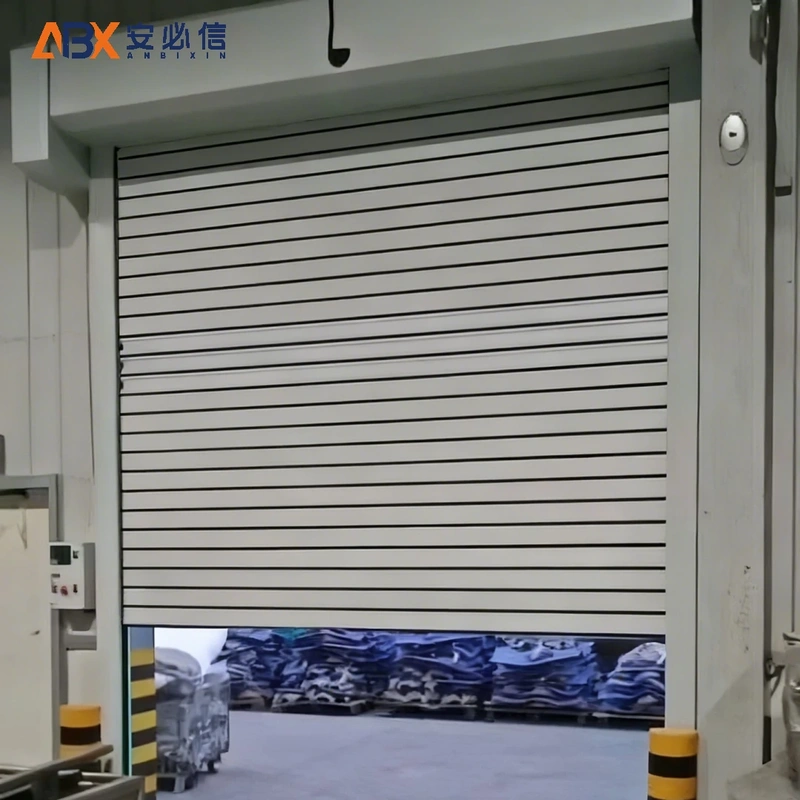
A turbine hard-shell high-speed door is a rigid slat door whose leaf is guided through a turbine-shaped spiral track above the opening. The slats follow the curved guide into a compact parked position, which keeps the header shallow while holding the closed leaf flat against wind pressure.
How the turbine guide carries the leaf
The guide is a continuous curved track rather than a straight vertical run. As the door opens, each slat enters the curve and the package rolls into itself above the opening. The slats stay engaged in the track throughout, so the leaf cannot leave its guides under suction on an exposed wall.
Because the curve distributes the turning load across several slats at once, the hinges see a lower peak stress than in a straight lift where the whole stack changes direction at one point. That is the mechanical reason this construction tolerates high cycle counts on external bay entrances.
Where the construction earns its cost
The turbine arrangement is normally chosen for an external opening that is used continuously and faces weather. Typical positions are dispatch bays, transfer corridors between production and warehousing, and entrances where a vehicle waits close to the door.
- Exposed elevations where the wind class has to be held while the door cycles.
- Openings with a header zone that is deep enough for the spiral but not for a vertical lift.
- High-cycle traffic where hinge and roller life dominates the maintenance cost.
- Positions where a vehicle may clip the leaf and the slats have to stay in the guide.
Headroom, structure and the parked package
The parked package occupies a defined envelope above the opening. Its depth is a function of the clear height and the slat pitch, so a tall opening needs a deeper header zone than a low one. That envelope has to be checked against the building services before the door is ordered, because moving a sprinkler branch after the guides are fixed is far more expensive than selecting a different construction.
The guides transfer wind load into the jambs, and the header carries the weight of the parked package. Both need a structural fixing detail, not a generic anchor schedule.
Sealing and thermal behaviour
The perimeter seal is compressed against the guides and the floor rather than brushed, which gives a defined leakage path when the door is closed. The joints between slats are a repeating thermal bridge, so the insulation value of the assembly is lower than the value of a single slat.
On a cold-store boundary the turbine guide is also where frost appears first, because the guide is the coldest continuous metal path through the assembly. Heated guides and a threshold that can drain address that failure mode directly.
Drive sizing and commissioning
The drive has to accelerate the slat mass and hold it at the travel limits without shock. A variable-frequency drive with adjustable acceleration and deceleration is the normal arrangement; the commissioned values are recorded because a later change of traffic pattern usually requires them to be re-tuned.
Commissioning checks the full travel at the widest opening, the reversal response of the bottom edge on an uneven floor and the behaviour of every interlock input. Those results belong in the handover record, together with the cycle counter reading at handover.
Maintenance items specific to this guide
Wear in a turbine door concentrates where the slats change direction. The guide rollers, the hinge pins and the curve segments are the parts to inspect, and they are inspected with the door at several positions in its travel rather than only closed.
| Item | What is checked | Typical interval |
|---|---|---|
| Guide rollers | Free rotation, flat spots, play in the carrier | Every service visit |
| Hinge pins | Wear, lubrication, slat alignment across the curve | Every service visit |
| Curve segments | Wear track, fixing tightness, debris build-up | Twice a year |
| Bottom seal | Compression, cuts, airbag integrity | Every service visit |
| Balance and drive | Holding force, brake response, acceleration settings | Twice a year |
Structural support the shell actually needs
The curved shell transfers load into the header along its full length rather than at a few brackets, so the header beam has to be continuous and straight over the opening width. A beam that sags between supports shows up as a tight spot in the guide and as uneven seal compression at the bottom, long before anything visible cracks.
On a steel frame the shell is usually fixed to a dedicated header member rather than to the cladding rails. On a concrete structure the fixings are set into cast-in channels or chemical anchors sized for the combined wind and dead load. Both details belong on the structural drawing, not in a generic anchor schedule, because the guide cannot be shimmed to compensate for a flexible header.
Related guides in this series
The following pages cover the adjacent decisions in the same product family, so the specification can be reviewed end to end.
- Complete guide to rigid high-speed doors
- Spiral versus turbine guide geometry
- Wind load classes to EN 12424
- Preventive maintenance schedule
References to verify before ordering
The table lists the references that normally change the selected configuration. It is a specification checklist, not a certification statement for any particular installation; the applicable class is confirmed against the measured opening and the site conditions.
| Reference | What has to be confirmed |
|---|---|
| EN 12424 | Wind class held by the closed leaf on the exposed elevation |
| EN 12426 | Air permeability at the perimeter seals |
| EN 12453 | Safety in use, including the reversal function of the bottom edge |
| EN 12604 | Guide and header fixing loads transferred into the structure |
| EN 13241 | Product standard covering the complete door assembly |
Frequently asked questions
What does hard-shell mean on a high-speed door?
It refers to the rigid slat leaf and its enclosing guide, as opposed to a fabric curtain. The slats form a shell that stays flat under wind load and remains captive in the turbine track.
Is a turbine door suitable for a very tall opening?
It can be, but the parked package grows with clear height and needs a correspondingly deep header zone. Above a certain height a different construction or a different guide geometry is usually more economical.
How does it behave if a forklift hits the leaf?
The slats are captive in the guide, so the usual outcome is local slat damage rather than a leaf leaving its track. Damaged slats are replaced individually, which is why the slat pitch and spare parts should be recorded at handover.
Why do heated guides appear in cold-store specifications?
Because the guide is the coldest continuous metal path through the assembly, condensate freezes there first. Heating the guide prevents ice from blocking the track and damaging the rollers.
Gallery