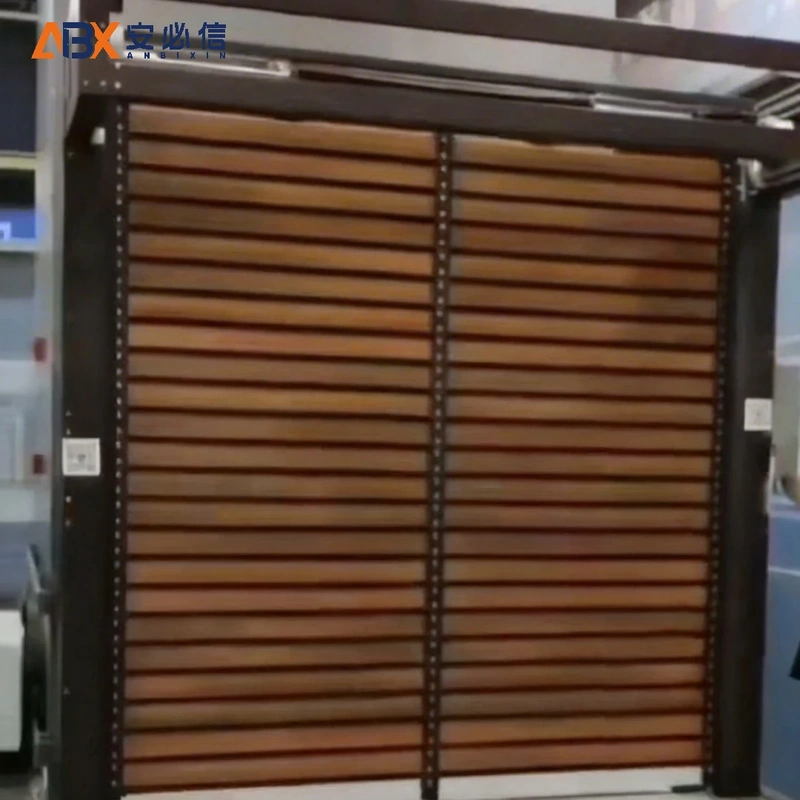
A rigid high-speed door is a power-operated industrial door whose leaf is made from interlocking rigid slats rather than a flexible curtain. The slat package travels in a guided track at opening speeds typically between 0.5 and 2.5 m/s, so the door combines a short open time with a defined wind class and a sealed perimeter on an exposed elevation.
What the word rigid changes in practice
The leaf of a rigid door is a stack of insulated slats hinged to each other. Because the slats are rigid, the closed door keeps a flat plane under pressure difference and stays in its guides under wind load. A flexible curtain of the same opening size would deflect, lift out of the side guides and lose its seal long before the structure of the building was at risk.
That single mechanical difference drives the rest of the specification: heavier leaf, stronger guides, a drive sized for the slat mass, a header zone deep enough to park the stack, and a perimeter seal that can be compressed rather than brushed. It also sets the cost position, because a rigid door needs more steel around the opening than a curtain door of the same clear dimensions.
The five constructions and where each one fits
Rigid high-speed doors are not one product. The guide geometry, the slat material and the fire performance separate them into constructions with different limits, and choosing between them is the first real decision in a specification.
| Construction | How the leaf is parked | Where it is normally chosen |
|---|---|---|
| Turbine hard-shell | Slats run in a spiral turbine guide above the opening | High-cycle external bay entrances where wind and impact both occur |
| Spiral | Slats wind into a compact spiral inside a header box | Openings with limited headroom that still need thermal separation |
| Metal | Steel slat package in a reinforced guide | Heavy industrial traffic, cart and forklift impact, harsh environments |
| Aluminium | Light alloy slats in a spiral or turbine guide | Wide openings where leaf weight would otherwise drive the structure |
| Fire-rated | Slat package with a rated closing mechanism | Compartment boundaries that must close on a fire signal |
The construction also sets the practical opening width. Aluminium and spiral packages scale further than a heavy steel leaf before the drive and the header structure become the limiting cost.
Speed is a means, not the objective
Opening speed matters only in relation to how long the aperture would otherwise stay clear. A door running at 1.5 m/s on an opening that is held open for two minutes during a pallet transfer saves almost nothing; the same door on a crossing that takes four seconds saves most of the exchange.
The useful figure is the total open time per shift, not the catalogue speed. It is calculated from the number of cycles, the travel time in each direction, the closing delay and the time the door is held open by an operator or a vehicle detector. Where that number is high, the next step is usually a change of traffic procedure rather than a faster door.
Cycle duty decides service life more than any other figure
Every opening and closing is a load cycle on the slat hinges, the guide rollers, the balance system and the bottom seal. A door rated for 100 cycles a day and asked to run 600 will fail early regardless of the brand, and the failure will appear first in the parts that are hardest to reach.
Cycle counts should be taken from the controller rather than estimated. A week of logged data during peak production is more reliable than an annual average, because the peak week sets the wear rate and the maintenance interval.
| Daily cycles | What the duty rating has to cover | Typical consequence of under-rating |
|---|---|---|
| Under 50 | Standard industrial drive, occasional inspection | Little risk; the door is closed most of the day |
| 50 to 200 | Industrial drive with soft start and stop | Brake and bottom seal wear accelerate first |
| 200 to 600 | High-cycle drive, recorded cycle counter, planned spares | Guide rollers and hinges become the limiting parts |
| Above 600 | Purpose-built high-cycle drive and a service contract | Any undersizing shows as repeated unplanned stops within months |
Wind load and the exposed elevation
A rigid door on an external wall is loaded by pressure on the closed leaf and by suction as wind passes the opening. The classification in EN 12424 expresses that as a class, and the class required is a property of the building elevation, not of the door type. A door chosen for an internal partition and moved to an exposed façade will not hold its class, however rigid the slats are.
The specification should state the class, the exposure of the elevation and whether the door is the primary wind closure or sits behind another element. Where the opening is deep or the façade is a corner, local pressure effects usually raise the requirement above the value taken from the basic wind speed alone.
Thermal separation, sealing and condensation
Insulated slats reduce conduction through the leaf, but the air that leaks around the perimeter often carries more energy than the leaf conducts. The bottom seal, the side gaskets, the joint between the guide and the wall, and the way the door meets an uneven floor determine the real performance of the assembly.
Where a cold room meets a warm space, moisture condenses on the coldest surface. That is normally the guide, the threshold or the bottom seal rather than the centre of the leaf, which is why heated guides and a drainable threshold appear in cold-store specifications and thicker slats alone do not solve the problem.
Controls, safety devices and interlocks
A high-speed door is fast enough to be dangerous, so the safety function is part of the control design rather than an accessory. The usual arrangement is a monitored bottom edge, photocells across the opening, an emergency stop at each side and a controller that refuses a closing cycle while any input is active.
Interlocks extend that logic to the process. Conveyors, airlocks, dock levellers and traffic lights should be wired so that the door cannot be commanded into a state that conflicts with them. The interlock sequence belongs in the commissioning record, because it is the part most often lost when a controller is replaced.
The specification sequence that avoids rework
The parameters interact, so they are best settled in an order that stops a later decision from invalidating an earlier one.
- Measure the clear opening, the headroom and the obstruction envelope above it.
- Establish the wind class from the elevation and its exposure.
- Fix the daily cycle count from logged traffic, not from a nominal figure.
- Choose the construction from width, headroom, wind class and cycle duty together.
- Define the sealing arrangement at the threshold, the guides and the wall junction.
- Select the safety devices and write the interlock sequence with the process equipment.
- Agree the maintenance interval, the wear parts held on site and the access needed.
- Record the commissioned settings against the door schedule.
Installation interfaces that decide whether it works
The door is fixed to a structure that was built for something else. The jamb and header have to carry the fixing loads of the guides and the parked slat stack, and the header zone has to stay clear of sprinklers, lighting, conveyors and crane rails. These are checked on site before the order, not resolved during installation.
At the threshold, the floor tolerance, the drainage line and the finish determine whether the bottom seal can close across the full width. On a wide opening a floor that falls away by a few millimetres leaves a gap that no adjustment of the door can close.
Where a rigid door is the wrong choice
A rigid door is a poor fit where the opening is very wide and lightly used, where the available headroom cannot take the parked stack, or where the wall cannot carry the fixing loads without new steel. In those cases a stacking or curtain door covers the opening with far less structure.
It is also the wrong choice for an internal partition with no wind or temperature requirement: the mass and the guides buy nothing that a light curtain door does not already provide.
What the first year of operation usually reveals
The first year shows which assumptions in the door schedule were wrong. The most common findings are a cycle count higher than the estimate, a floor that settles at the threshold, and a seal that wears faster on one side because the guide was set a few millimetres out of plumb. None of these is a product fault, and all of them are cheaper to correct during the first service than after the warranty period.
The useful routine for that year is a short quarterly review of the controller's fault log against the cycle counter. A door that completes its cycles with no entries is ready for a longer service interval; a door with a rising fault rate is telling you which part is about to fail. That single habit replaces most of the guesswork in a maintenance budget.
Related guides in this series
The following pages cover the adjacent decisions in the same product family, so the specification can be reviewed end to end.
- Turbine hard-shell construction
- Wind load classes to EN 12424
- Insulation and air infiltration
- Rigid versus PVC high-speed doors
References to verify before ordering
The table lists the references that normally change the selected configuration. It is a specification checklist, not a certification statement for any particular installation; the applicable class is confirmed against the measured opening and the site conditions.
| Reference | What has to be confirmed |
|---|---|
| EN 13241 | Product standard for industrial, commercial and garage doors and gates |
| EN 12424 | Wind resistance class of the closed door on the exposed elevation |
| EN 12426 | Air permeability of the closed assembly |
| EN 12428 | Thermal transmittance where temperature separation is required |
| EN 12453 | Safety in use of power-operated doors |
| EN 12604 | Mechanical aspects and fixing loads |
Frequently asked questions
What is a rigid high-speed door?
It is a power-operated door whose leaf is a stack of interlocking rigid insulated slats, guided in a track and driven at high opening speed. The rigid leaf holds a flat plane under wind and pressure load, which is what separates it from a flexible curtain door.
How fast does a rigid high-speed door open?
Models in this family typically run between 0.5 and 2.5 m/s depending on size and drive. The useful figure for a project is the total open time per shift, calculated from cycle count, travel time and closing delay, not the catalogue top speed.
Can a rigid high-speed door be used externally?
Yes, provided the wind class is established from the elevation and its exposure and the fixings are detailed for the resulting loads. An internal-rated door moved to an exposed façade will not hold its class.
What headroom does the door need above the opening?
The parked slat stack needs a header zone whose depth depends on the construction and the clear height. Spiral and turbine guides are more compact than a straight vertical lift, but the exact figure comes from the selected model and must be checked against sprinklers, lighting and conveyors.
Which parts wear out first?
The bottom seal, the guide rollers, the slat hinges and the balance system, in that order on most high-cycle installations. Cycle counts recorded by the controller let the maintenance interval follow real use instead of a calendar.
Gallery