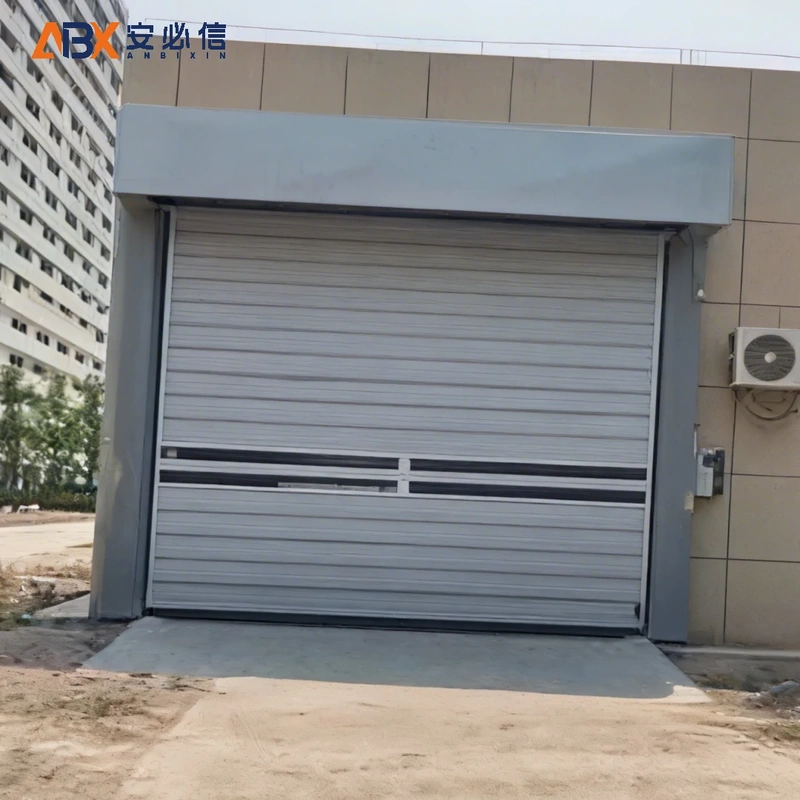
Rigid and PVC high-speed doors both shorten the time an aperture is open, but they solve different problems. A rigid door holds a wind class and a temperature boundary on an exposed elevation; a PVC curtain door provides fast, economical zoning on sheltered internal openings where leaf mass and structure are limited.
The four conditions that decide it
The comparison comes down to four conditions, and any one of them can decide the choice on its own.
| Condition | Rigid slat door | PVC curtain door |
|---|---|---|
| Wind exposure | Holds a declared class on an external wall | Limited; the curtain deflects under pressure |
| Temperature separation | Insulated slats with a compressible perimeter seal | Possible, but the curtain and seals carry less insulation |
| Impact tolerance | Slats damaged locally and replaced; leaf stays guided | Curtain deflects and re-enters the guide; self-repairing guides help |
| Structure and headroom | Needs a header zone and stronger fixings | Light header box, minimal structural load |
When the opening is external
An external opening is loaded by wind and by the pressure difference between inside and outside. A rigid door is the default answer because the leaf keeps its plane and the seal stays in contact. A curtain on the same elevation will lift out of its guides in gust conditions and will not hold a temperature boundary.
When the opening is internal and busy
An internal partition between two production zones is sheltered, lightly loaded and often crossed hundreds of times per shift. A curtain door is lighter, cheaper to install and faster for the same drive size. Where a vehicle clips it, the self-repairing guide lets the curtain re-enter on the next cycle instead of stopping production.
Cost, considered properly
The purchase price of a curtain door is lower. The comparison that matters is the cost over the life of the opening: structure, drive size, energy through the opening, curtain replacement and downtime.
- Rigid: higher structure and door cost, lower energy loss on a temperature boundary.
- Curtain: lower installation cost, curtain treated as a wear item.
- Rigid: repairs are slat-level and can be planned.
- Curtain: impact usually means a curtain re-entry or replacement, not a stoppage.
A mixed arrangement is often correct
Many plants use both: a rigid door on the external elevation and curtain doors on the internal partitions behind it. That arrangement puts the wind and thermal duty where the rigid construction earns its cost, and the cycle duty where the light construction is cheaper to run.
A decision checklist for the project meeting
Four questions settle most of these comparisons before any product discussion. Is the opening on an external elevation with wind exposure? Does the door separate two temperatures that must not mix? Is the daily cycle count above roughly two hundred? Is there a vehicle route that passes within reach of the leaf?
Two or more "yes" answers point to the rigid construction. All "no" answers point to the curtain, which will be cheaper to install and easier to repair. The value of the checklist is that it separates the technical decision from the preference for a particular supplier, which is where most of these debates actually start.
Impact cost, stated plainly
A curtain damaged by a forklift usually re-enters its guide on the next cycle, at the cost of a few minutes. A rigid leaf in the same event loses slats, and the repair is planned work with a spare part. Neither is free, but the two costs fall in different budget lines: one is an interruption, the other is a maintenance purchase.
Related guides in this series
The following pages cover the adjacent decisions in the same product family, so the specification can be reviewed end to end.
- Complete guide to rigid high-speed doors
- Rigid versus sectional overhead doors
- Wind load classes to EN 12424
- Insulation and air infiltration
References to verify before ordering
The table lists the references that normally change the selected configuration. It is a specification checklist, not a certification statement for any particular installation; the applicable class is confirmed against the measured opening and the site conditions.
| Reference | What has to be confirmed |
|---|---|
| EN 12424 | Wind class, where the curtain alternative cannot comply |
| EN 12428 | Thermal transmittance across the boundary |
| EN 12453 | Safety in use for both constructions |
| EN 12426 | Air permeability comparison at the perimeter |
| EN 13241 | Product standard covering both door types |
Frequently asked questions
Can a PVC door be used externally?
Only where the elevation is sheltered and the wind class requirement is low. On an exposed wall the curtain deflects, loses its seal and can leave the guides.
Which is cheaper to run?
It depends on the duty. On a temperature boundary the rigid door usually loses less energy; on a sheltered internal opening the curtain usually costs less to install and maintain.
Which handles forklift impact better?
A curtain deflects and can re-enter its guide, which avoids a stoppage. A rigid leaf is damaged locally and repaired slat by slat, which costs more per event but keeps the seal.
Can the two types share the same opening?
Not in the same frame. They are usually used at different positions in the same building: rigid outside, curtain inside.
Gallery