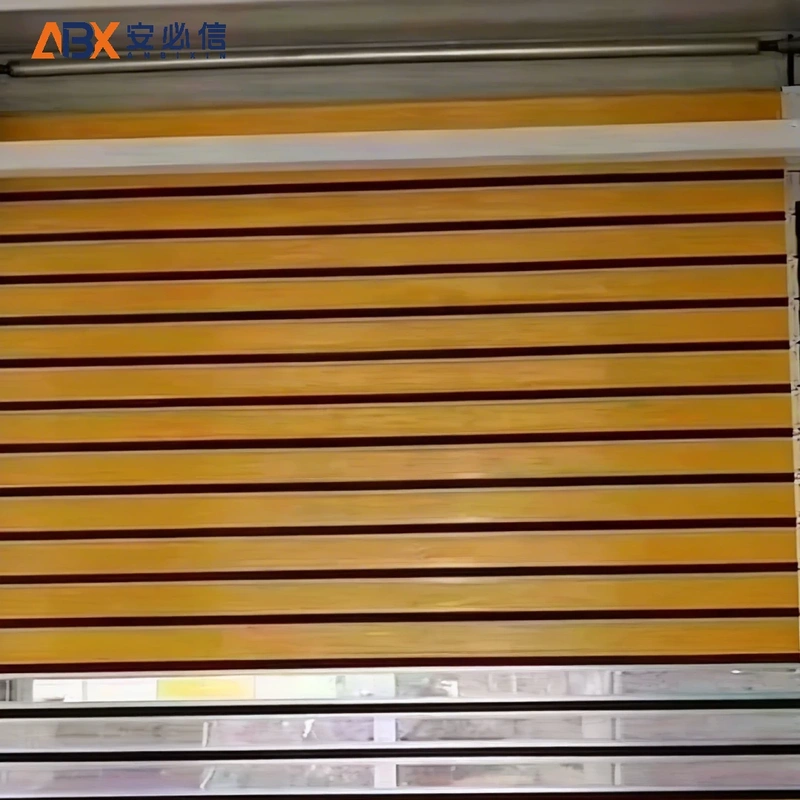
Thermal performance of a rigid high-speed door is the combined effect of conduction through the slats, air leakage around the perimeter and the time the door spends open. Of these three, the perimeter leakage and the open time usually dominate the energy actually lost through an industrial opening.
Three mechanisms, one number
Conduction through the leaf is the mechanism most often discussed and usually the smallest term. Air passing the seals carries both sensible and latent heat, and an open aperture exchanges air at a rate that no leaf insulation can offset.
| Mechanism | Driven by | Reduced by |
|---|---|---|
| Conduction through slats | Slat insulation value and joint design | Thermal break, thicker slat, fewer joints |
| Infiltration at seals | Seal compression, floor tolerance, guide clearance | Compressible seals, flat threshold, correct guide adjustment |
| Open-aperture exchange | Open time per cycle and cycle count | Faster cycle, shorter closing delay, better traffic procedure |
Estimating infiltration honestly
Infiltration is normally expressed as a leakage rate at a reference pressure difference and declared under EN 12426. For an energy estimate, the useful approach is to combine that leakage with the measured open time rather than to assume the door is closed all day.
On a cold-store entrance the latent load is the larger part: moist air entering the room deposits frost on the evaporator, and the defrost cycles that follow cost more than the sensible heat gain.
Where condensation forms first
Condensation appears on the coldest continuous surface, which in a typical installation is the guide, the threshold or the bottom seal. The centre of an insulated slat is usually warmer than those points, so a thicker slat does not move the condensation problem.
- Guides: continuous metal path from the cold side to the warm side.
- Threshold: cold floor slab in contact with warm, humid air.
- Bottom seal: thin section with little insulation and direct contact with the floor.
- Slat joints: repeating thermal bridge along every hinge line.
Design responses that work
Heated guides keep the track above dew point. A drainable threshold gives meltwater somewhere to go. A thermal break in the slat stops the joint acting as a fin. A door position that avoids a direct path between a warm and a cold zone reduces the driving pressure difference.
None of these is expensive relative to the cost of ice in a guide or a frozen bottom seal, which is why they belong in the specification rather than in a post-commissioning fix list.
Verifying performance after installation
The verification that matters is functional: does the door close onto a flat threshold across the full width, does the bottom seal compress evenly, do the side gaskets touch along their length, and does the guide stay dry through a shift.
Those checks are done with the door in service, not only at handover, because seals settle and guides move in the first weeks of operation.
Measuring open time instead of assuming it
The open time per shift is usually estimated, and the estimate is usually low. The controller can report it: total open time, number of cycles and average open duration are available on most industrial drives, and a week of that data is more useful than any assumption about traffic.
Where the controller cannot report it, a simple count over one shift gives the figure: number of cycles multiplied by the measured open duration, plus the time the door is held open manually. That number explains most of the difference between two buildings with identical doors and very different energy bills.
Related guides in this series
The following pages cover the adjacent decisions in the same product family, so the specification can be reviewed end to end.
- Cold store interfaces and frost
- Eight parameters that decide the door
- Spiral construction and shallow headers
- Rigid versus PVC high-speed doors
References to verify before ordering
The table lists the references that normally change the selected configuration. It is a specification checklist, not a certification statement for any particular installation; the applicable class is confirmed against the measured opening and the site conditions.
| Reference | What has to be confirmed |
|---|---|
| EN 12428 | Thermal transmittance of the door assembly |
| EN 12426 | Air permeability at a reference pressure difference |
| EN 12425 | Water penetration resistance on exposed elevations |
| EN 12424 | Wind class, since deflection affects seal contact |
| EN ISO 13788 | Assessment of interstitial condensation risk |
Frequently asked questions
Is a thicker slat worth the cost?
Only after the perimeter seals and the open time have been addressed. On most industrial openings the leakage and the open time carry more energy than conduction through the leaf.
Why does ice form on the guides and not on the slats?
Because the guide is the coldest continuous metal path through the assembly. Moisture condenses and freezes there first, even when the slat face stays above dew point.
How is infiltration measured?
It is declared as a leakage rate at a reference pressure difference under EN 12426. For energy estimates it is combined with the actual open time per shift.
Does a faster door always save energy?
Only when the aperture would otherwise stay open longer. Where the door is held open during loading, changing the traffic procedure saves more than increasing the speed.
Gallery