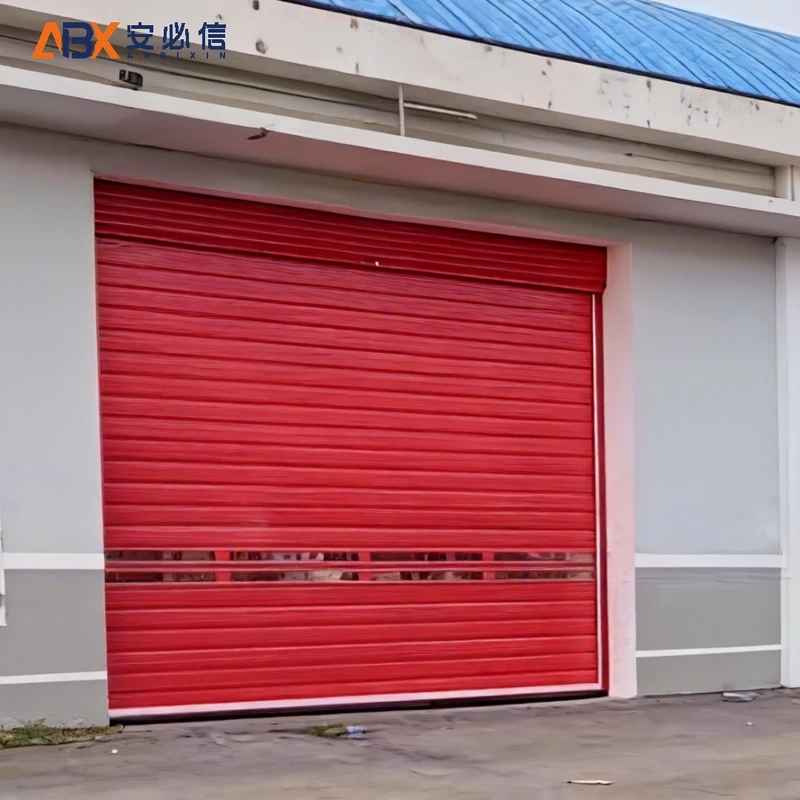
A cold store door interface is the assembly where a temperature-controlled room meets a warmer space: the door, its guides and threshold, the wall junction and the drainage. Frost and condensate form on the coldest continuous path through that assembly, so the interface is designed as a system rather than as a door alone.
The physics that drives the design
Warm air holds more moisture than cold air. When warm, humid air reaches a surface below its dew point, water condenses; below freezing, it becomes frost. At a cold-room opening the warm side is usually a loading bay with vehicle exhaust and outside air, so the moisture load is high.
The driving force is the pressure difference between the two spaces, which pushes air through every gap. Sealing therefore matters more than insulation at this interface.
Where it fails first, in order
The failure sequence is predictable because it follows the coldest continuous path through the assembly.
- The threshold: a cold slab in contact with warm air, often with no drainage.
- The guides: a continuous metal path from the cold side to the warm side.
- The bottom seal: thin, cold and in contact with a wet floor.
- The slat joints: repeating bridges along every hinge line.
- The wall junction: a gap hidden behind a cover plate.
Details that actually work
Each detail below addresses one part of the problem and leaves the rest unchanged, which is why they are specified together.
| Detail | What it solves | What it does not solve |
|---|---|---|
| Heated guides | Ice in the track and frozen rollers | Condensation on the slat face |
| Drainable threshold | Meltwater pooling at the floor line | Air leakage past the bottom seal |
| Thermal-break slat | Condensation along the joints | Frost on the guides |
| Air curtain or vestibule | Open-aperture exchange during transfers | Leakage when the door is closed |
| Correct closing delay | Open time per cycle | Seal condition |
Vehicle and dock coordination
At a refrigerated dock the door is one element of a sequence that includes the dock shelter, the leveller and the vehicle restraint. If the shelter does not seal against the trailer, the door closes onto a bay full of outside air and the frost load increases regardless of the door specification.
Interlocking the door with the restraint prevents the door being commanded while a trailer is repositioning, which is also when the shelter seal is least effective.
Operating routine for a winter shift
Frost accumulates during the shift and is removed at the end of it. A routine that includes a visual check of the guides and threshold, a check that the drain is clear and a recorded floor temperature gives early warning before a door freezes shut.
Where a door has frozen, forcing it open damages the seal and the guide. The correct response is to clear the ice and confirm the heating circuit is working before the next cycle.
The drain and the floor fall
Meltwater has to go somewhere, and the detail that decides whether it does is the floor fall at the threshold. A slab that falls away from the door pushes water into the room; one that falls towards the door needs a drain on the warm side, below the seal line and clear of the traffic path.
The drain is usually omitted because the door was specified before the civil works. Adding it afterwards means cutting the slab at the busiest point of the opening. Raising the detail at the design stage costs a shallow channel and a gully; omitting it costs a winter of ice at the threshold and a seal replacement every season.
Related guides in this series
The following pages cover the adjacent decisions in the same product family, so the specification can be reviewed end to end.
- Insulation and air infiltration
- Spiral doors in cold-store entrances
- Preventive maintenance schedule
- Complete guide to rigid high-speed doors
References to verify before ordering
The table lists the references that normally change the selected configuration. It is a specification checklist, not a certification statement for any particular installation; the applicable class is confirmed against the measured opening and the site conditions.
| Reference | What has to be confirmed |
|---|---|
| EN 12428 | Thermal transmittance across the temperature boundary |
| EN 12426 | Air permeability, the dominant term at this interface |
| EN 12425 | Water penetration resistance on the warm side |
| EN 12453 | Safety during closing on a wet or icy threshold |
| EN ISO 13788 | Condensation risk assessment for the assembly |
Frequently asked questions
Why does ice form on the guides when the slats stay dry?
The guide is the coldest continuous metal path through the assembly, so it reaches dew point before the slat face does. Heating the guide addresses the cause.
Is a thicker insulated slat the answer to condensation?
Only partly. Condensation follows the coldest surface, which is normally the guide, threshold or bottom seal rather than the middle of the slat.
Should the door stay closed during loading?
Where the dock shelter seals against the trailer, yes: closing the door during loading reduces the moisture load. Where the shelter does not seal, the benefit is smaller.
How is a frozen door released?
By clearing the ice and restoring the heating circuit, not by forcing the leaf. Forcing damages the seal and the guide and usually causes a second failure.
Gallery