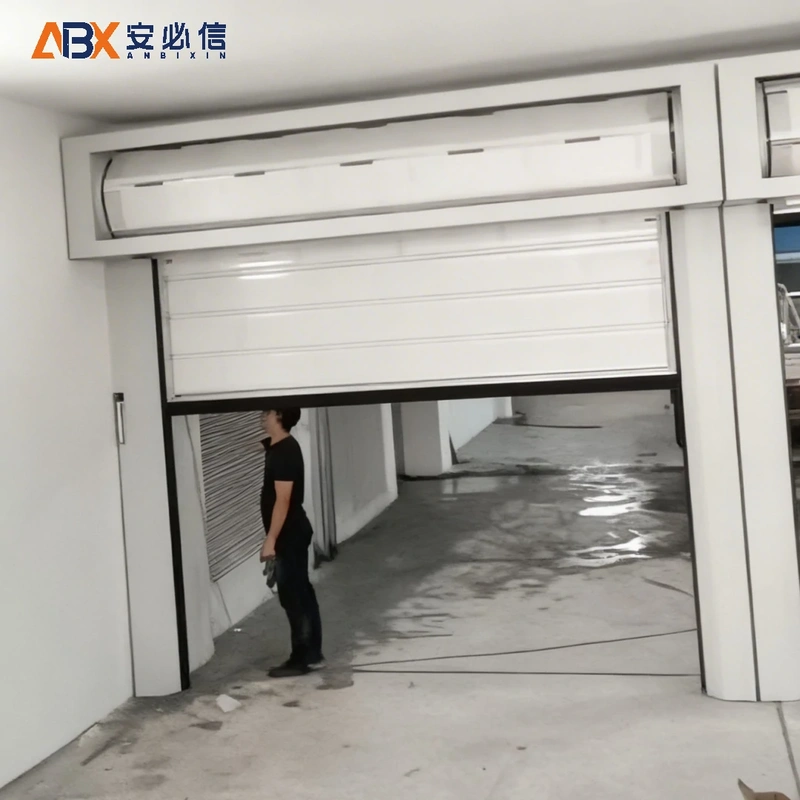
EN 12453 is the standard for safety in use of power-operated doors, and it governs how a high-speed door detects a person or object in its path. Compliance is demonstrated through the device combination, the force limits, the control logic and a recorded test of the reversal function.
The device set and what each one covers
The device set is decided by the traffic through the opening, not by the size of the door. The table shows what each device actually covers.
| Device | What it detects | What it does not cover |
|---|---|---|
| Monitored bottom edge | Contact with a person or object under the closing leaf | Approach from the side above the edge |
| Through-beam photocells | An object crossing the opening at beam height | A person standing below the beam |
| Presence detection (radar or area) | Movement in the aperture before closing starts | A stationary person in a blind area |
| Emergency stop | Deliberate intervention by an operator | Automatic detection of any kind |
| Audible and visual warning | Warning before movement | Detection |
Coverage is decided by traffic, not by door size
A vehicle-only opening needs coverage of the swept area and a bottom edge that reverses on contact. An opening shared with pedestrians needs presence detection that holds the door open while someone is in the aperture, because a person can stand still below a photocell beam.
Where a door is part of an automated sequence, the safety devices also feed the sequence: a conveyor must not advance into a closing leaf, and an airlock must not release the second leaf while the first is open.
Force limits and why speed changes the risk
A high-speed leaf carries more kinetic energy than a slow one, so the force limit and the reaction time matter more. The controller measures the force during the closing cycle and reverses when the limit is exceeded; the reaction time is part of the type test and should not be altered without re-testing.
The test that proves it still works
Testing is a physical act: place a test piece of the specified dimensions in the path, close the door, and confirm it reverses. Repeat at the positions defined in the standard, including near the closed position where the force is highest.
- Record the date, the test piece dimensions and the observed reaction.
- Test each device separately, not as a combined function.
- Re-test after any change to the controller, the drive or the seals.
- Keep the record with the door schedule, not only in the maintenance file.
Common failures found in service
Photocells contaminated by dust, misaligned after a knock, or bypassed during a breakdown are the most frequent findings. A monitored edge that has lost its air pressure is the second. Both are silent failures until the door is tested.
The practical answer is a short functional test at every service visit, not only an annual inspection, because the interval between failures is shorter than the service interval on a busy door.
Commissioning the safety functions with the process
The safety devices protect people from the door, but they also have to work with the equipment around it. Commissioning should therefore test the combined behaviour, not each device in isolation: a conveyor that keeps running while the door reverses, or an airlock that releases its second leaf while the first is still open, is a hazard that no door-mounted device can address.
The test sequence is written with the process supplier, executed once with production stopped, and recorded with the observed reaction at each step. Any later change to the conveyor, the airlock or the controller requires the sequence to be repeated, because the interlock logic is only as good as its last verification.
Related guides in this series
The following pages cover the adjacent decisions in the same product family, so the specification can be reviewed end to end.
- Drive, control and commissioning
- Fire-rated doors and closing sequences
- Preventive maintenance schedule
- Complete guide to rigid high-speed doors
References to verify before ordering
The table lists the references that normally change the selected configuration. It is a specification checklist, not a certification statement for any particular installation; the applicable class is confirmed against the measured opening and the site conditions.
| Reference | What has to be confirmed |
|---|---|
| EN 12453 | Safety in use of power-operated doors |
| EN 12604 | Mechanical aspects and safe clearances |
| EN 12978 | Protective devices for power-operated doors |
| EN 13241 | Product standard for the complete assembly |
| EN ISO 13849-1 | Control system safety performance level |
Frequently asked questions
Are photocells enough for a pedestrian route?
No. A person can stand below the beam. A pedestrian route needs presence detection that holds the door open while the aperture is occupied.
How often should the reversal test be done?
At every service visit on a busy door, and after any change to the controller or the drive. The result is recorded with the test piece dimensions.
What is a monitored safety edge?
An edge that reports its own integrity to the controller. If it loses signal or pressure, the door will not close, which prevents a silent failure.
Can the safety devices be bypassed for production?
Only under a documented temporary procedure with an alternative safeguard and a defined restoration time. A permanent bypass removes the compliance basis of the installation.
Gallery