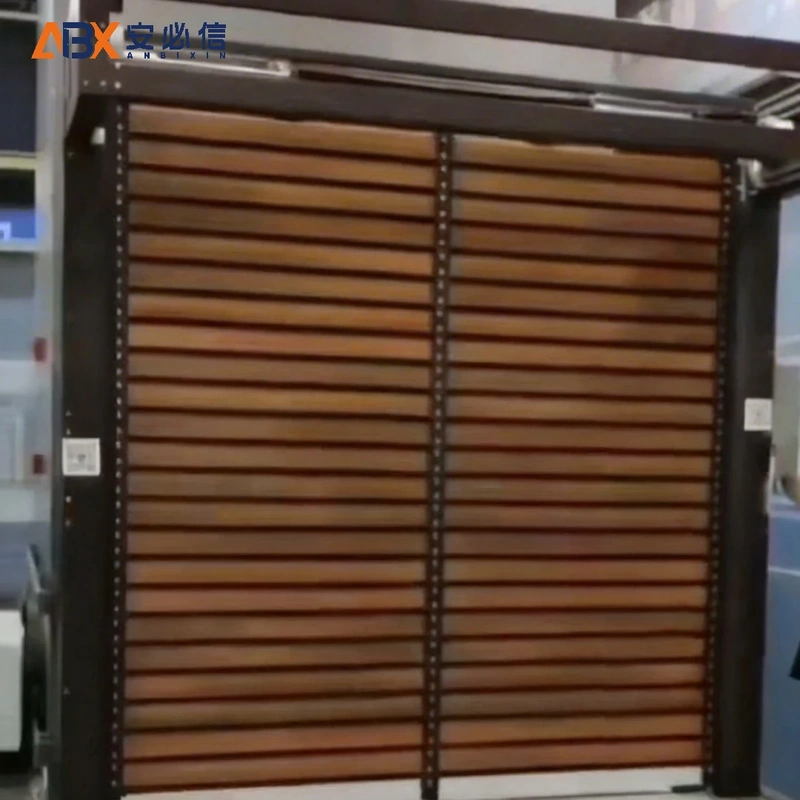
The drive and control system of a high-speed door convert a traffic command into a controlled movement of a heavy leaf. Commissioning sets the travel limits, the acceleration and deceleration ramps, the closing delay and the reversal sensitivity, and records them so the behaviour can be reproduced after service.
Sizing the drive to the real duty
The drive has to accelerate the leaf mass, hold it at the limits and brake it without shock, at the real cycle rate. A drive rated for the leaf weight but not for the cycle count will overheat in summer and wear its brake early.
Variable-frequency control is normal on this class of door because it lets the acceleration and deceleration profiles be tuned to the leaf. A direct-on-line motor with a mechanical limit produces a shock at each reversal that the hinges absorb.
Inputs the controller should accept
The controller has to accept commands, safety inputs and process interlocks as separate classes of signal. The list below is the normal set.
- Traffic commands from radar, induction loops, pull cords or a manual station.
- Safety inputs from the bottom edge, photocells and the emergency stop.
- Process interlocks from conveyors, airlocks, dock levellers and traffic lights.
- Status outputs to a building management system or a warehouse controller.
The interlock logic is the part that differs most between projects. It should be written as a sequence with the process supplier, not left to the door supplier to infer from a wiring diagram.
The settings that define behaviour
Six settings define how the door behaves in service. Each one has a characteristic failure when it is wrong.
| Setting | Effect if wrong | When to review |
|---|---|---|
| Travel limits | Leaf parks short or over-travels into the header | After slat or guide work |
| Acceleration ramp | Hinge shock, noise, premature roller wear | After a duty change |
| Deceleration ramp | Hard stop at the closed position, seal damage | After a duty change |
| Closing delay | Either trapped traffic or excessive open time | After a traffic pattern change |
| Reversal sensitivity | Either nuisance reversals or an unsafe closing force | Every safety test |
| Interlock timing | Conflicting commands with process equipment | After any process change |
Commissioning checks beyond the door
Commissioning confirms the door works with the building, not only on its own. That means checking the behaviour of the bottom edge on the actual floor, the response of each interlock, the state reporting to the panel and the reaction of the door when a vehicle stops inside the aperture.
The handover record should contain the commissioned values, the cycle counter reading, the safety test results and the contact for spares. Without the values, the next technician starts from default settings.
Fault codes worth logging
Most industrial door controllers record a fault code and a cycle count at the moment a cycle stops. That pair of values is the most useful diagnostic data the installation produces, and it is usually overwritten or ignored.
Logging the code, the position and the cycle count at each event builds a picture of the door's behaviour over months. A code that appears once after a cleaning shift is contamination; the same code appearing every few thousand cycles is a developing alignment or seal problem. Recording the values costs a line in the service report and replaces most of the guesswork in the next diagnosis.
Handover items the next technician will need
Beyond the settings, three items save the most time later: the wiring diagram as installed rather than as designed, the input and output list with the terminal references, and the contact who can supply a controller parameter file. A controller replaced without its parameter file has to be re-commissioned from scratch, which usually means a day of production lost to a task that takes twenty minutes.
Related guides in this series
The following pages cover the adjacent decisions in the same product family, so the specification can be reviewed end to end.
- Safety devices and EN 12453
- Eight parameters that decide the door
- Diagnosing unplanned stops
- Preventive maintenance schedule
References to verify before ordering
The table lists the references that normally change the selected configuration. It is a specification checklist, not a certification statement for any particular installation; the applicable class is confirmed against the measured opening and the site conditions.
| Reference | What has to be confirmed |
|---|---|
| EN 12453 | Safety functions implemented in the control system |
| EN ISO 13849-1 | Performance level of the safety-related control parts |
| EN 13241 | Product standard covering the drive and controls |
| EN 12604 | Mechanical limits and clearances |
| EN 61000-6-2 | Electromagnetic compatibility in industrial environments |
Frequently asked questions
Why does the door need a variable-frequency drive?
To control acceleration and deceleration so the leaf does not shock its hinges at each reversal, and to allow the profile to be tuned to the installed leaf mass.
Can the door controller talk to a warehouse system?
Yes, through status outputs and command inputs. The signal list and the interlock sequence are agreed with the process supplier before commissioning.
What happens if the settings are lost?
The door reverts to defaults and behaves differently: slower ramps, different closing delay, different reversal sensitivity. The handover record exists to prevent that.
How often should the settings be reviewed?
After any change of traffic pattern, drive, controller, slat or seal. Otherwise an annual review with the safety test is sufficient.
Gallery